



Grayson County could soon have a dozen tornado shelters around the county.
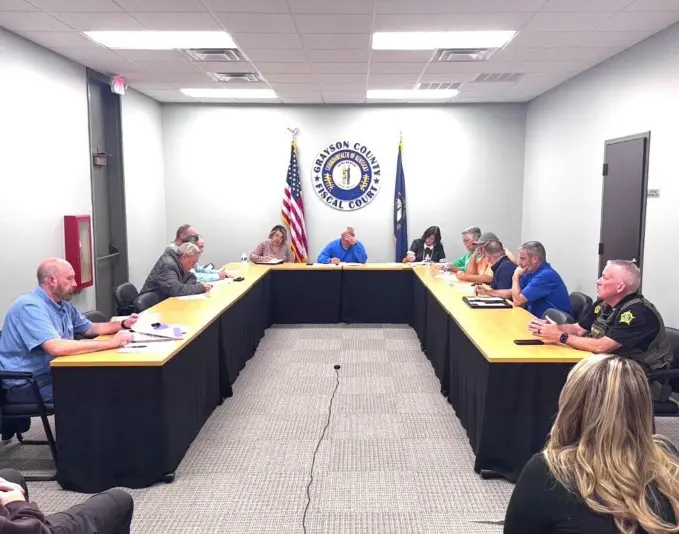
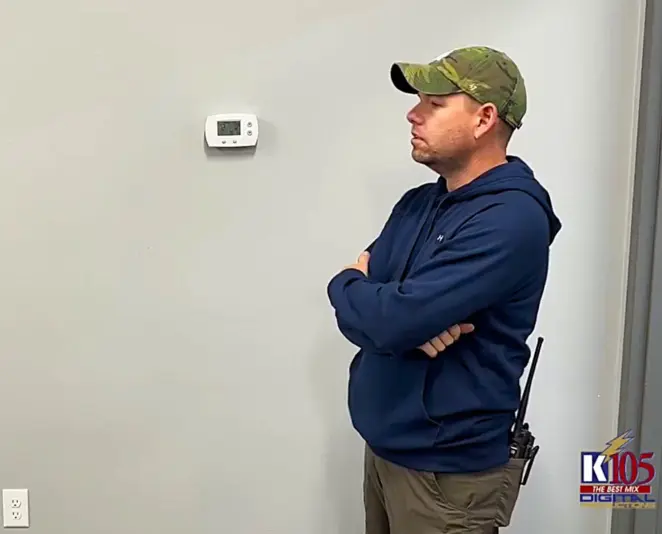
At Thursday’s Grayson County Fiscal Court meeting, Grayson County Emergency Management (GCEM) Deputy Director Blake Schroerlucke formally requested magistrates approve GCEM applying for a partially matching $426,000 FEMA grant to install 12 tornado shelters in the county.
“I got with Blake and (GCEM Director) Carey Sims probably about a year ago, I guess, and told them I want tornado shelters all over the county,” Judge-Executive Kevin Henderson said.
After waiting out a federal government shutdown, Henderson stated, GCEM is now clear to apply for the grant.
Schroerlucke told magistrates that the shelters, which would hold 25 people, contain electricity and have a concrete pad, would be installed at fire departments and other locations around Grayson County.
The FEMA grant GCEM is applying for is a 75/25 matching grant, meaning FEMA would pay 75 percent of the cost of the construction while the county would pay 25 percent.
Magistrates unanimously approved the request.
Shift in “Tornado Alley”
Kentucky has seen an increase in tornadic activity over the last several years due to a “gradual eastward trend in the atmospheric environments capable of supporting severe weather and tornado development,” according to the Southwest Ohio Regional Weather Center.
The following is a statement posted on Wednesday by the Southwest Ohio Regional Weather Center regarding increased tornadic activity in the Ohio Valley (and other regions) and its possible causes:
“One topic that has gained increasing attention within the meteorological community over the last several years is the idea that parts of ‘Tornado Alley’ may be gradually shifting farther east toward regions such as the Midwest, Mid-South, Southeast, and portions of the Ohio Valley.
“Traditionally, Tornado Alley has been associated with the central Plains, including states like Texas, Oklahoma, Kansas, and Nebraska. These areas still remain some of the most tornado-prone regions in the world and continue to experience a large amount of severe weather each year.
“However, research and long-term severe weather trends have shown increasing tornado activity farther east compared to historical averages.
“This does NOT mean the Plains are no longer active.
“Instead, it suggests that environments supportive of severe thunderstorms and tornadoes may be becoming more common across parts of the eastern United States, including portions of the Ohio Valley.
“States such as Kentucky, Tennessee, Arkansas, Mississippi, Alabama, Indiana, Illinois, and Ohio have all experienced periods of increased tornado activity in recent years. Some studies have also shown a gradual eastward trend in the atmospheric environments capable of supporting severe weather and tornado development.
“One reason this topic is important is because tornadoes occurring farther east can often become more dangerous from a public safety perspective compared to the open Plains.
“Across the Plains, visibility is often much better due to flatter terrain and fewer trees. In contrast, the Ohio Valley and Southeast contain dense tree coverage, rolling hills, larger population centers, and a greater risk for nighttime tornadoes. These factors can make tornadoes much harder to visually identify and can reduce warning response time for the public.
“Another major factor meteorologists are studying is moisture availability.
“The Gulf of Mexico supplies warm, humid air northward into the United States, which is one of the key ingredients for severe thunderstorms. Some research suggests that stronger and more frequent surges of Gulf moisture into the Midwest and Ohio Valley may be helping create more favorable severe weather environments farther east.
“Jet stream patterns, atmospheric wind shear, instability, storm-track placement, and broader climate variability may also be contributing factors.
“At the same time, it is important to understand that tornado records from decades ago are not perfect.
“Modern Doppler radar technology, storm spotter networks, smartphones, social media, and increased population coverage now allow meteorologists to detect many weaker tornadoes that may have gone undocumented years ago. Because of this, some of the apparent increase may partially be related to improved detection and reporting methods rather than only atmospheric changes alone.
“Meteorologists continue researching this topic heavily, and while there is evidence supporting an eastward expansion in tornado activity, the exact causes are still being studied.”
(Photo: Grayson Co. Emergency Management Deputy Director Blake Schroerlucke speaks to Grayson Co. Fiscal Court regarding a FEMA grant application to install tornado shelters throughout the county)
By Ken Howlett, News Director
Contact Ken at ken@k105.com